This post was written by Dr. Alan M. Yahanda, president, Parkview Packnett Family Cancer Institute.
In January of 2025, the Surgeon General released a report entitled “Alcohol and Cancer Risk.” In the report, alcohol consumption was linked to at least seven types of cancer and named as the third leading preventable cause of cancer in the United States. People had questions about what amount of drinking was dangerous, what types of alcohol were problematic and the truth behind the recommendations. We answer these questions by discussing the history of these recommendations and what the data says now.
What’s the history of alcohol and cancer? I remember reading that a glass of red wine per day is good for me!
The link between alcohol and cancer has, historically, been conflicting. For example, some reports stated that some consumption, such as red wine, reduced the risk of cancer. Others said that light to moderate drinking was not a concern. Some more recent data suggests that alcohol consumption may decrease the risk of kidney cancer.
What are we to make of all this conflicting information? A direct relationship between alcohol consumption causing or increasing the risk of cancer has been hard to prove. For example, could other high-risk factors like smoking or obesity are known to increase cancer risk be causing that increased risk. If someone smokes and drinks, it is difficult to know which factor is responsible.
What does recent data say?
Growing scientific data over the past 40 years, when looked at as a whole, offers solid scientific evidence of an association between alcohol and cancer. The sheer volume of data from large population studies smooths out the contributions of other risk factors besides alcohol use, allowing us to draw clearer conclusions.
The strongest evidence for a relationship between alcohol and cancer comes from several large studies that compiled data from multiple international research publications. Expert scientists evaluated and ranked the evidence. They used this ranking to draw conclusions about the risk of developing cancer from alcohol consumption.
Based on the studies mentioned above, consumption of alcohol is associated with an increased risk of developing the following cancers:
- oral cavity
- throat
- larynx
- esophagus
- liver
- colorectal
- breast
How does alcohol increase cancer risk?
We don’t have a definitive answer for how alcohol increases risk of cancer. From animal and laboratory studies, we know that alcohol is metabolized in the body to produce acetaldehyde, a known carcinogen that binds to and damages cellular DNA. Another theory is that alcohol can generate oxygen-free radicals, molecules that can react with and damage cellular DNA and proteins. Lastly, there is evidence that alcohol and tobacco smoking can act together to increase the body’s absorption of toxic compounds into the body, particularly through the lining of the mouth, throat and larynx.
Does it matter how much I drink?
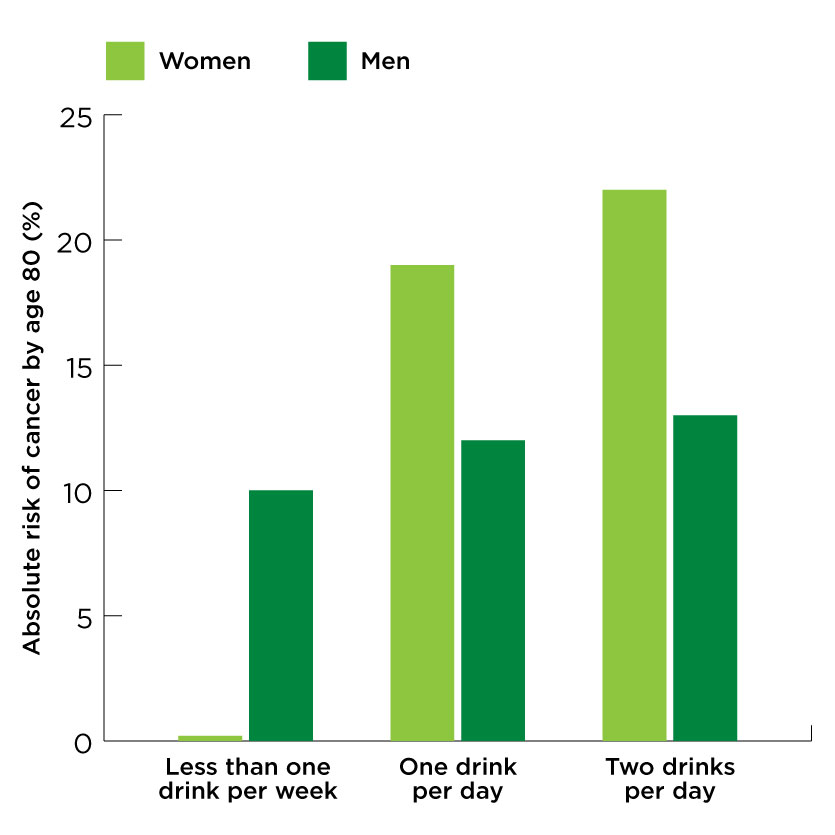
There does appear to be a relationship between the amount of alcohol consumed and the risk of cancer, as illustrated in the accompanying graph taken from the Surgeon General’s report. In the accompanying graph, the risk of women and men consuming less than one drink per week represents the baseline cancer risk. Moving to the right on the graph, the consumption of even one drink per day will increase cancer risk. This trend continues to increase for two drinks per day or more. According to the World Cancer Research Fund, there is no level of alcohol consumption that would be considered totally free of cancer risk.
Are there types of alcohol that are less risky than others?
Most experts believe that the risk of cancer is elevated no matter the type of alcohol consumed. Strong evidence is lacking regarding the type of alcohol and cancer risk, since most studies only measure the amount but not the type of alcohol consumed. Some studies suggest that wine may not have as high a risk of cancer compared to an equivalent quantity of beer and spirits, but that evidence is not strong.
What should I do?
Your decision to consume alcohol is a personal one and should be based on your informed risk assessment. The real-world value of the graph above is meaningless without putting the risk in context.
At baseline (first bars on the left side of the accompanying graph) for women consuming no or little alcohol, the average risk of developing a cancer over a lifetime is 16.5%, or about 17 out of 100 women. For those consuming two drinks per day, that average risk goes up to 21.8%, or 22 out of 100 women. This means that over the course of a lifetime, approximately 5 more women out of 100 will develop cancer secondary to alcohol consumption of two drinks per day. It should be noted that this risk is an average across multiple cancer types; the number of women that will develop cancer will vary based on the cancer type.
Another way to understand the risk is to evaluate it on a population level and at an individual level. Across a whole population, which is the viewpoint of the Surgeon General study, a 5% increase in cancer resulting from alcohol could mean hundreds of thousands of new cancer cases. This increase would certainly be worth addressing. At the individual level, however, you must determine if a 5% increased risk on average is compelling enough to change behavior. It’s up to the individual to make that choice.
The bottom line
The bottom line is that alcohol consumption is associated with increased cancer risk, that the risk increases with the amount of alcohol consumed, and that the overall increase in cancer risk for the individual is relatively small, but present.
Parkview Packnett Family Cancer Institute offers cancer risk reduction and assessments for qualifying patients. Start your risk reduction journey.
References
The US Surgeon General’s Advisory. Alcohol and Cancer Risk. Office of the US Surgeon General (2025).
World Cancer Research Fund and American Institute for Cancer Research. Alcoholic Drinks and the Risk of Cancer (2018).
Bargnardi V, et al. Br J Cancer; 112(3):580-93 (2015)
IARC Working Group on the Evaluation of Carcinogenic Risks to Humans. IARC Monograph.
World Health Organization, International Agency for Research on Cancer (1988).
Peterson H. Nature; 639:290-292 (2025).